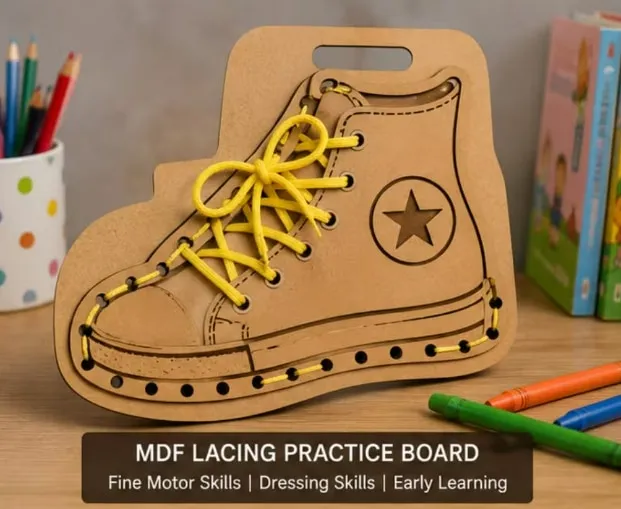
A lacing board is only useful when its holes, cord, edges and difficulty suit the child using it. Before you place an order, define the play experience, check toy-safety details and compare MDF with alternative materials so the finished board is safe, durable and easy to maintain.
Key takeaways
- Match hole spacing, cord length and board size to the child’s age.
- Specify rounded edges, secure cords and non-splintering, sealed MDF.
- Compare MDF with wood, plastic and felt for durability and cleaning.
- Request a prototype, drawing and safety-check details before production.
How a child uses a lacing board and what to specify by age
A child should be able to pick up the cord, push its tip through a hole, pull the cord through without tangling it, and follow a visible path from the starting point to the finish. This repeated push-pull action builds hand-eye coordination, bilateral hand use and fine-motor control.
A custom lacing practice board for kids works best when the first attempt feels achievable, not like a puzzle.
Specify difficulty by changing one feature at a time:
- Ages 2–3: Use a large, sturdy board with widely spaced holes, a thick short cord and a simple outline. The child practises inserting, pulling and removing the cord with close adult supervision.
- Ages 3–4: Add a clear start and finish, a larger number of holes and a basic animal, vehicle or geometric shape. The child follows the outline rather than lacing randomly.
- Ages 4–6: Use closer hole spacing, longer paths, direction changes and two or more colours. Add a name, letter or number only after the child can complete a simple outline.
- Ages 6 and above: Introduce smaller holes, crossing routes, repeating patterns or several lacing designs on one board. Let the child plan the route and correct missed holes independently.
Do not make every feature harder at once. A smaller hole combined with a thinner cord and a complex pattern can turn practice into frustration; increase hole density or pattern complexity after the child completes the current layout confidently.
Specify whether the cord is included, and keep detachable beads or decorative tips out of the beginner version.
Dimensions and features to include in your purchase specification
A usable board leaves enough room for a child’s hands without becoming awkward to hold. Specify the overall length and width, MDF thickness, hole diameter, hole-to-hole spacing, corner radius, and finished edge treatment rather than ordering by a picture alone.
| Feature | Specify | Why it matters |
|---|---|---|
| Overall size | Board dimensions and usable margin around the pattern | A cramped layout makes fingers collide with edges; an oversized board is difficult for small hands to steady. |
| MDF thickness | One fixed thickness, recorded on the drawing | Thin MDF flexes or breaks around holes; thick MDF adds weight. |
| Holes | Diameter, spacing, and distance from the outer edge | Small holes reject the cord tip, while close holes leave too little material between them. |
| Edges and corners | Sanded or sealed edges, rounded corners, and acceptable laser discolouration | A laser cut MDF toy board can arrive with brown char, soot, or rough resin residue unless the finish is stated. |
| Cord | Exact length, material, tip construction, and whether it is supplied | A cord that is too long tangles; a blunt tip frustrates threading and a loose tip changes the task. |
| Pattern layout | One path or several, with names, letters, colours, or shapes shown on the artwork | Clear spacing prevents overlapping paths and keeps the board readable. |
For repeat orders, freeze the approved dimensions, hole layout, cord specification, finish, engraving, and packing method in one controlled drawing or signed sample. Otherwise, a replacement board can match the stated length while feeling entirely different in use.
Safety checks for cords, holes, edges and toy compliance
Before allowing use, inspect the finished board by hand and treat every cord, hole and coating as a possible failure point.
1. Run a finger around every face, hole and outside edge. Reject the board if you find a sharp corner, splinter, raised MDF fibre, laser residue, exposed fastener or point that can scratch skin. Tug every eyelet, bead, knot and decorative piece; nothing should detach with ordinary handling.
2. Check the hole pattern for break-out. Thin webs between adjacent holes, or between a hole and the edge, can split when a child pulls the cord. Ask for a sample laced under tension, not only a photograph of the cut file.
3. Examine the cord from tip to end. It must have secure, smooth tips without loose strands, detachable caps or hard sharp ends. Measure the supplied length and supervise younger children; a cord can wrap around fingers, wrists or the neck. Remove the board if the cord frays or its end fitting loosens.
4. Request the MDF grade, thickness, supplier or batch traceability, surface finish and coating system. “MDF” alone does not prove low formaldehyde emissions, edge strength or moisture resistance. Test paint or clear coat on the actual MDF: it must not raise fibres, create a persistent odour or obscure engraved guidance.
5. If you intend to buy an mdf lacing board in noida, specify it as a toy, not a decorative panel. Ask which Toys (Quality Control) Order, 2020 and applicable BIS conformity evidence covers the product, including required lab records and Standard Mark details.
MDF versus wood, plastic and felt: which board suits your use?
Price is only one part of the decision: compare each material for hole strength, edge handling, moisture resistance, cleanability, coating safety and expected use. For an mdf lacing board in noida, also specify it as a toy, because the Toys (Quality Control) Order, 2020 brings applicable BIS conformity requirements into manufacture and sale.
| Material | Strengths | Trade-offs |
|---|---|---|
| MDF | Flat, consistent surface; precise custom shapes and engraved patterns; economical for repeat production | Moisture can swell the fibres; laser-cut edges may show brown or black char, soot and resin residue; thin webs between holes can split |
| Solid wood | Attractive grain, good rigidity and repairability | Grain variation affects cutting and hole edges; splinters, knots and heavier weight require inspection |
| Plastic | Wipe-clean, moisture-resistant and suitable for bright colours | Can crack at small holes, feel slippery and create sharp fragments after breakage; some plastics are unsuitable for laser cutting |
| Felt | Soft, quiet and light; useful for simple threading practice | Holes stretch, fray and lose shape; it is harder to clean thoroughly and offers less structural feedback |
Select MDF when you need accurate customisation and controlled dimensions. Specify the minimum web between adjacent holes and between each hole and the outside edge; adding holes without increasing thickness weakens the board.
Ask for the actual MDF sample with its proposed paint or clear coat. The finish can hide engraved contrast, raise fibres, change odour and extend drying time. State whether laser-edge discolouration is acceptable, or require sanding and coating, then assess the cord separately for pull-out, knot security and detachable end pieces.
How to order and approve a custom board from a Noida manufacturer
If you plan to buy MDF lacing board for kids in Noida, send the maker a toy specification, not a decorative-panel brief. State the child age, board dimensions, MDF thickness, hole diameter and spacing, cord length and material, tip design, patterns, colours, name or letter engraving, and whether the cord is included.
Specify that the product must meet the applicable requirements under India’s Toys (Quality Control) Order, 2020, including BIS conformity requirements.
1. Send two separate files: a closed-vector cut file for the outer profile and holes, and an artwork file for engraving or marking. Mixing both layers can make the laser cut an engraving line.
2. Name the coating, colour, gloss level and clear coat, then request testing on the actual MDF. Coatings can hide engraved contrast, raise fibres, change odour and extend drying time.
3. Ask for a physical first article made with the intended MDF batch, laser power, speed, focus and engraving depth. Check hole edges, engraving readability, surface splinters, cord knots, tips, beads and eyelets before approval.
4. Measure the web between neighbouring holes and between each hole and the outside edge. Thin sections can split during lacing or pull testing even when the cut is dimensionally accurate.
5. Approve a signed master sample, drawing and tolerance sheet. For each batch, compare dimensions, hole positions, coating, engraving and detachable parts against that record.
Laser Job Services can be evaluated like any wooden lacing board manufacturer in Noida: approve the sample before authorising repeat production.
Related product
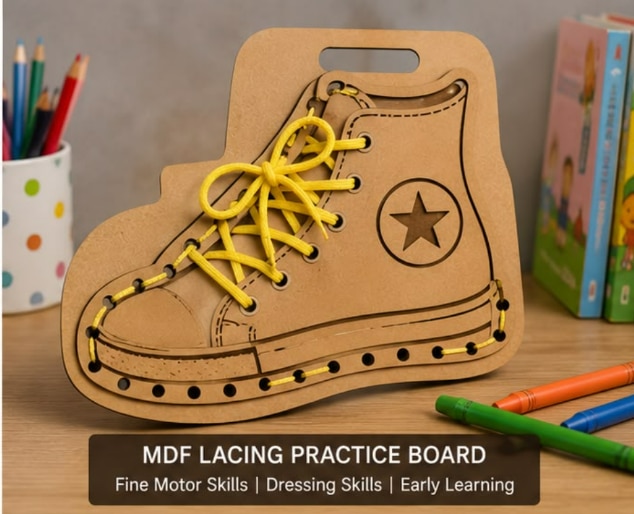 | MDF Toys For Kids MDF Lacing Practice Board for Kids Laser Job Services is a manufacturer of precision laser-cut MDF products, offering creative and educational activity products for children. View product → |
Frequently asked questions
How should a lacing board change by a child’s age?
Adjust the board size, hole spacing, cord thickness, path complexity and cord length to the child’s hand control and experience.
What dimensions and features should you specify when buying a custom lacing board?
Specify board length and width, MDF thickness, hole diameter and spacing, path layout, cord type and length, edge treatment, and finish.
What safety checks should a children’s lacing board pass?
Check for secure cords, holes without sharp edges, smooth sealed surfaces, no loose parts or splinters, and toy-compliance documentation for your market.
Is MDF better than wood, plastic or felt for a lacing board?
MDF suits precise laser-cut shapes and consistent production; wood offers a natural finish, plastic resists moisture, and felt provides a softer lightweight surface.
How do you approve a custom lacing board from a Noida manufacturer?
Send a written specification, approve the drawing and prototype, inspect the first sample, and confirm materials, finish, packaging and production quantities before ordering.
Keywords