A custom insert order is more than a foam shape cut to match a product. You need to know which design files, material decisions, samples, tests, assembly steps and delivery details belong in the quotation before approving production. By the end, you will have a checklist for comparing suppliers and accepting the finished packaging.
Key takeaways
- Demand a CAD layout showing cavities, walls, radii, lifts and accessory pockets.
- Specify foam density, thickness, colour, fire requirements and cutting tolerances in writing.
- Approve a prototype using the real product before ordering the full insert quantity.
- Check every finished insert against the approved drawing and packing list.
What should a custom PE foam insert quotation include?
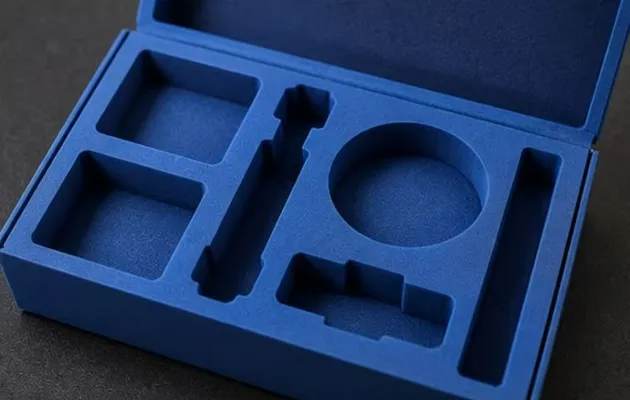
A complete quotation starts with a design consultation and review of your product drawing, 3D CAD file, physical sample or dimensioned photographs. Before cutting, require the supplier to prepare or revise the CAD drawing and show the cavity layout, foam thickness, minimum wall, corner radius, finger lifts, accessory pockets and lid or cover arrangement.
- PE type, density, colour, thickness and number of cavities
- Cutting method, edge finish, marking and quantity
- Construction: single foam block, laminated layers, tray with lid, or separate top and bottom pieces
- For laminated inserts, adhesive type, bond requirement and controls for adhesive squeeze-out
2. Make the commercial scope explicit. State whether CAD preparation, programming, prototype cutting, revisions, inspection, assembly, labelling, packing and delivery are included or charged separately. A PE foam packaging insert service in Noida can cover design assistance, prototyping, production cutting and delivery, but none of these deliverables is automatic.
3. Confirm the drawing revision code and the approval point that releases production. Put rejected-piece replacement, inspection records, packaging of the inserts and delivery to your Noida site in the purchase scope. The quotation should name the inspection basis and identify the sample or drawing that production must follow.
This prevents a low price from hiding excluded design work, unapproved revisions or a delivery charge.
Which measurements and layout details prevent a poor fit?
Measure the product at its largest overall length, width and height, then record every feature that changes the cavity: handles, knobs, connectors, cable exits, hinges, brackets, feet, switches and protruding fasteners. Mark the insertion direction and the surfaces allowed to touch the foam.
- Measure the case or carton’s inside length, width and height, including lid clearance and internal ribs.
- Specify retention force: the product must stay restrained during handling without excessive removal force.
- Show cavity depth, projection clearance, support beneath the product, finger lifts, corner radii and minimum web between neighbouring cavities.
- Add accessory dividers, a removable top or bottom layer for deep items, and a lid compression layer where the closed case presses on the foam.
- Test worst-case product dimensions, including manufacturing variation, before freezing the layout.
- Use cavity numbers, orientation arrows and part or revision codes when operators load several items consistently.
- Specify shallow marking locations; deep engraving reduces the remaining foam section and can start a tear.
A product outline alone is not a layout. A tight cavity can transfer shock into fragile projections, while a loose cavity permits movement, impact and abrasion.
| Fit choice | Likely result | Layout response |
|---|---|---|
| Tight cavity | Strong restraint but projection damage from transferred shock | Increase clearance around fragile features and add compliant support |
| Loose cavity | Product movement, impact and abrasion | Reduce cavity size or add retention features |
| Correct restraint | Secure handling without difficult extraction | Validate insertion, removal and lid pressure in a prototype |
These measurements give a custom foam insert cutting in Noida project enough information to produce a protective, loadable insert rather than a visually accurate outline.
Which foam grade, thickness and cutting process fit the job?
A “custom PE foam” request is incomplete: specify EPE (expanded polyethylene), non-cross-linked PE, cross-linked PE or XLPE, antistatic PE, or conductive PE. These grades differ in stiffness, compression recovery, surface finish, static control and cost. Choose density and thickness from product mass, centre of gravity, drop risk and contact points—not by choosing the softest sheet.
| Option | Main advantage | Limitation |
|---|---|---|
| PE | Closed-cell liquid resistance and durable recovery | Grade and density still determine support |
| EVA | Firm, clean-looking finish | Usually costs more than basic PE |
| PU | Softer cushioning | Open-cell structure absorbs more contamination |
| EPE | Lightweight, economical cushioning | Lower support and surface refinement |
| Corrugated card | Low material cost | Less resilient contact protection |
Heavy items need support beneath the base and around projections. Painted or polished surfaces need non-marking contact and controlled retention. For electronics, optics and medical items, confirm cleanliness, odour, abrasion, plasticizer, adhesive and outgassing limits.
A protective foam packaging manufacturer in Noida may offer CNC knife cutting, die cutting, routing, sawing, waterjet cutting or laser processing. Ask which method is quoted.
- Choose die cutting for repeat, high-volume geometry when tooling cost and shape limits are acceptable.
- Request a process sample for laser cutting: PE edges can melt, shrink or fuse, while smoke requires effective ventilation and fume control.
- Choose cold cutting over laser for heat-sensitive surfaces, very thick sections or narrow webs that cannot survive edge treatment.
What does a PE foam packaging prototype in Noida prove?
A PE foam packaging prototype in Noida proves production readiness only when it is a fit-test iteration, not an attractive one-off sample. Use the intended foam grade, density, thickness and production cutting method whenever possible; hand-cut samples reveal layout, but not tolerances affected by compression, kerf, edge melt or dimensional recovery.
1. Load the actual product and check cavity clearance, insertion direction, extraction force, finger access, product movement, lid pressure and support beneath the centre of gravity.
2. Repeat insertion and removal. Look for abrasion, crushed walls, torn webs and loss of foam recovery, then record the product’s condition before and after each cycle.
3. Test the packed unit in relevant drop orientations. Examine vibration, compression, corner contact and movement inside the case or carton, not just the insert on a workbench.
4. For transport packaging, record the test level and orientation under ASTM D4169 or the applicable ISTA procedure. A correct bench fit does not prove transit qualification.
5. If the shipment requires UN 4G packaging requirements, verify the complete certified packaging system. The foam insert alone is not the certification.
6. Approve changes using a marked-up drawing, sample number and revision code. A failed or borderline test can require a revised cavity, altered wall, different density or second sample before production release.
What should arrive with the finished insert order?
Release payment only after the shipment matches the approved construction, inspection basis and packing method. Confirm whether the supplier assembles laminated layers, installs a removable top or bottom piece, fits the insert into the case, applies labels or packs components separately.
Request these order controls:
- Mark cavity numbers, orientation arrows, customer part numbers and revision codes where warehouse or production staff load items.
- For electrostatic-sensitive products, specify antistatic or conductive foam, the target resistance range, and IEC 61340-5-1 or ANSI/ESD S541 handling requirements. Colour alone proves nothing about static control.
- Require inspection of cavity length, width, depth, wall thickness and critical openings. This does not replace drop, vibration or compression testing.
- State quantity per carton, dust and moisture protection, carton identification, delivery address and the replacement process for damaged or rejected pieces.
| Item | Confirm before delivery | Failure if omitted |
|---|---|---|
| Construction | Single block, laminated layers, tray with lid, or separate top and bottom pieces | Layers, covers or assembly arrive unusable |
| Marking | Depth, location, contrast and marking method | Deep marks weaken walls or operators load parts incorrectly |
| Documentation | Approved drawing, material specification, inspection record and revision code | Delivered inserts cannot be traced or accepted |
A supplier offering custom pe foam for packaging inserts in Noida should provide an itemised scope, not a generic protective-insert description. Laser Job Services is worth comparing when you need design review, custom foam insert cutting in Noida, marking, assembly and delivery; request a process sample.
For repeat volumes, compare laser cutting with die cutting. Choose another process for soft cushioning, very thick sections or heat-sensitive contact surfaces. Link every delivered insert to the approved drawing.
Related products
 | PE Foam Laser Cutting Foam Laser Cutting – Packaging Insert Our Foam Laser Cutting Services specialize in manufacturing custom packaging inserts that provide superior protection for delicate products, tools,... View product → |
 | PE Foam Laser Cutting PE Foam Laser Cutting – Custom Packaging Box Inserts | Precision Laser Job Services Protect valuable products with our professional PE Foam Laser Cutting Services for custom packaging inserts,... View product → |
Frequently asked questions
What should a custom PE foam insert quotation include?
Request the material grade and density, foam thickness, dimensions, quantity, CAD design work, cutting method, tolerances, prototype charges, tooling or setup charges, packing, delivery schedule and taxes. The quotation should identify whether the price covers design revisions and a physical sample.
Which measurements and layout details prevent a poor fit?
Provide the product’s maximum length, width, height, weight, centre of gravity, fragile surfaces, protrusions and required clearance. Confirm cavity depth, minimum wall thickness, corner radius, finger lifts, accessory pockets, lid clearance and the orientation of every item. Use a physical sample or 3D CAD file when possible.
Which foam grade, thickness and cutting process fit the job?
Choose closed-cell polyethylene foam when you need cushioning, moisture resistance and low particle shedding. Match density and thickness to the product’s weight, impact risk and shipping conditions. Ask whether the supplier will use CNC routing, knife cutting, die cutting or another process, because each affects edge quality, repeatability, cost and design flexibility.
What does a PE foam packaging prototype in Noida prove?
A prototype proves that the product enters and leaves the cavities, stays supported during handling, clears the lid, fits the outer packaging and leaves enough wall between cavities. Test it with the actual product, accessories and intended carton before approving production.
What should arrive with the finished insert order?
Check the quantity, approved drawing or revision number, material and thickness, cavity dimensions, edge finish, cleanliness and packaging. Confirm that the inserts match the approved prototype and that any required inspection report, replacement policy or batch identification accompanies the shipment.
Related products
 | PE Foam Laser Cutting Foam Laser Cutting – Tool Case Insert Our Foam Laser Cutting Services specialize in manufacturing custom tool case foam inserts that provide superior protection, organization, and... View product → |
 | PE Foam Laser Cutting Foam Laser Cutting – Packaging Prototype Our Foam Laser Cutting Services provide high-precision packaging prototype solutions for industrial products, electronics, medical equipment,... View product → |
Keywords