
A laser-cut bag panel is only as consistent as the pattern file, leather specification and approval sample behind it. By defining panel geometry, material limits, test features and inspection requirements before production, you can reduce misaligned seams, distorted holes, smoke staining and avoidable rework.
Key takeaways
- Build bag files at 1:1 scale and label every panel and operation.
- Approve leather type, thickness and finish before fixing laser settings.
- Use qualification samples to check edges, holes, smoke marks and fit.
- Compare in-house cutting with a leather panel cutting service in Noida.
Turn the Bag Pattern into a Production-Ready Cutting File
A production-ready bag file is a controlled assembly drawing, not just an outline. Build it at 1:1 scale in DXF, AI or SVG, and name each panel and operation so the operator cannot confuse a cut with a stitch mark.
- Draw separate closed profiles for the front, back, gusset, base, flap, pocket, handle tabs and reinforcement pieces. Add seam allowance only where the sewing method needs it, and mark fold lines without turning them into cut paths.
- Put through-cuts, stitch holes, fold references, logo engraving and registration marks on separate named layers or colours. State hole diameter, pitch, edge offset, corner radius and panel tolerances in the file notes.
- Define grain direction and the hide’s stretch direction with arrows. State whether panels may rotate during nesting, identify zones that must avoid scars or loose grain, and mark mirror-image parts explicitly as “left” and “right.”
- Dimension mating edges from the same datum. Include notches for gusset corners, handle positions and pocket alignment; otherwise individually accurate panels can still produce a twisted bag or shifted seam.
Check the file by overlaying stitched edges and folding the pattern digitally. The gusset length must match its joining edge after allowances, and mirrored panels must face correctly when finished.
Your purchase order must say whether the supplier is cutting supplied leather and supplied CAD, developing the pattern, or providing further work. A leather panel cutting service in Noida can cover different scopes. For custom leather bag panels in Noida, specify material, file revision, included operations, inspection records and reject handling.
Separate Every Panel and Dimension the Assembly Features
A dimensionally accurate cut can still assemble badly if the hide stretches differently from panel to panel. Separate and label every piece: front, back, gusset, base, flap, pocket, handle tabs and reinforcement pieces. Record grain direction, stretch direction, hide-side orientation and whether nesting may rotate a part.
- Add seam allowance to the pattern, not at the cutting machine. State its width for each seam, fold and turned edge.
- Dimension stitch-hole diameter, pitch, first-hole offset from the edge, corner-hole location and the maximum allowable hole-to-edge distance.
- Define fold lines, notches, registration marks and engraving on separate file layers. Mark left and right panels as mirrored parts rather than assuming the operator will flip them.
- Specify tolerances for outside length, width, hole position and gusset height. A ±0.5 mm hole-position tolerance does not control a 3 mm panel-width variation.
| Component | Measurements to release | Failure prevented |
|---|---|---|
| Front and back | Grain direction, outline, seam allowance, pocket and handle-tab reference points | Twisting and misplaced attachments |
| Gusset and base | Finished length, width, corner radius, fold marks and end allowances | Gaps at corners and uneven depth |
| Flap and pocket | Symmetry line, overlap, edge offset and hole pattern | Crooked closure and stitch misalignment |
| Tabs and reinforcements | Thickness, grain, hole pitch and bonding area | Weak handles and shifting layers |
Your purchase order must state whether the supplier cuts supplied files or develops patterns, and whether inspection records and rejects are included. This distinction matters when comparing leather laser cut bag panels in Noida with a full leather panel cutting service.
Approve the Leather Before You Approve the Laser Settings
Approve the hide before the settings: tannage, thickness, finish and chemical composition determine whether leather cuts cleanly, smells acceptably and assembles consistently. A 1,060-nm fiber laser is not a substitute for a CO₂ laser, which absorbs leather at approximately 9.3–10.6 µm.
1. Identify the leather precisely. Record vegetable-tanned, chrome-tanned, suede, oil-treated, painted, laminated or synthetic construction, plus nominal thickness, backing and colour. “Leather, 1.5 mm” is not a sufficient material specification.
2. Reject unknown chemistry until the supplier provides an SDS or composition statement. Do not laser PVC or vinyl; chlorine-containing fumes can damage equipment and create a serious inhalation hazard. Treat PU coatings, adhesives and rubberised backings as separate materials requiring their own approval.
3. Inspect the finish and temper. Heavy oil, wax, paint, foil, plastic film or laminate changes absorption and can produce dark edges, sticky residue, smoke or delamination. Soft hides also stretch during handling, so confirm grain direction, stretch direction and allowable defects.
4. Run a sample from the actual hide lot. Compare cut speed, edge colour, char, odour, soot and hole quality, then test skiving, folding, painting and gluing. A qualification for laser cutting leather for bags in Noida is valid only for the recorded material, lot and machine condition.
Retain the approved sample and parameter sheet. Requalify after changing thickness, colour, moisture, backing, finish, hide lot or lens condition; there is no universal setting for leather.
Use a Qualification Sample to Control Edges, Holes and Smoke Marks
Approve one physical qualification sample cut from the exact leather intended for production, not a substitute hide. A leather panel cutting service in Noida should use the specified tannage, nominal thickness, colour, finish and backing because chrome-tanned, vegetable-tanned, coated and suede leather can leave different edges and residues.
1. Include the most demanding geometry from the bag: the smallest stitch holes, tightest hole pitch, narrowest slots, sharpest corners, smallest radii and closest feature spacing. Check every hole for taper, blockage, enlargement and cracking; a large outer rectangle will not expose these failures.
2. Inspect the cut edge under normal lighting and by touch. Record darkening, charring, loose soot, melted coating, roughness, edge width and smoke odour, then compare the result with the approved appearance standard.
3. Process the sample exactly as the finished panel will be handled. Test skiving, folding, edge painting, gluing and stitching, because a clean-looking cut can still split during folding, contaminate adhesive or leave soot on thread and lining.
4. Confirm that mirrored panels, notches, registration marks and stitch holes assemble against the physical pattern. Measure hole diameter, pitch, edge offset and critical panel dimensions after cutting; record actual values against the drawing tolerances.
Reject the sample if smoke residue transfers to light fabric, the edge needs unplanned hand finishing, or any hole prevents needle passage. Attach photographs, measurements, leather identification and approved settings to the purchase order, and state whether cutting, inspection records, rejects and finishing are included. Ensure extraction and fire controls are verified before production.
Choose the Right Production Scope and Compare Cutting Economics
A supplier brief must define whether the supplier cuts your hides, uses your CAD files, develops patterns, engraves, assembles panels, or delivers finished bags. A label such as “leather panel cutting service in Noida” does not define the work. For leather product manufacturing in Noida, state the operation on the purchase order.
Laser Job Services should receive approved files, material identification, quantities, tolerances, inspection records and reject rules. Confirm source extraction, filtration and fire controls; a laser must not run unattended.
- Identify tannage, nominal thickness, finish, colour, backing and hide quantity. A thickness range alone cannot control edge colour or smoke.
- State panel count, grain direction, mirror pairs, seam allowances, stitch-hole pitch, edge offsets and acceptable dimensional tolerance.
- Define nesting approval, material yield calculation, edge-cleaning responsibility, packing method and the inspection report supplied with each batch.
- Require a physical approval sample showing soot, odour, edge appearance and compatibility with skiving, folding, painting or gluing.
- Reject PVC and vinyl substitutes; check the technical data sheet or SDS before cutting faux leather, PU leather or synthetic leather.
| Option | Cost drivers | Choose it when |
|---|---|---|
| Laser cutting | No dedicated die; machine time, nesting loss and edge-cleaning labour | Prototypes, short runs or frequently revised patterns |
| Die cutting | Die fabrication, setup and material yield | High-volume production with stable shapes |
| Hybrid | Die for repeat panels; laser for revisions or small parts | Mixed orders needing both speed and flexibility |
Related products
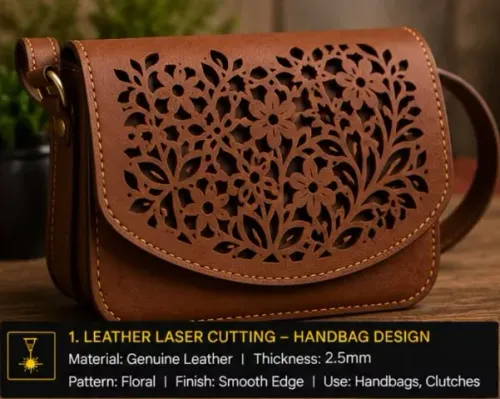
 | Leather Laser Cutting Leather Laser Cutting – Bag Panel Design | Premium Laser Job Services Create stylish and premium leather bags with our precision Leather Laser Cutting Services for handbags, tote bags,... View product → |
 | Leather Laser Cutting Leather Laser Cutting Handbag Design Leather Laser Cutting – Handbag Design | Premium Laser Job Services Enhance your leather handbags with our professional Leather Laser Cutting... View product → |
Frequently asked questions
What should a production-ready leather bag cutting file include?
Use a 1:1 DXF, AI or SVG file with separate, named panels and clearly identified cuts, stitch marks, holes and assembly features.
Why must you approve the leather before laser settings?
Leather thickness, tanning method, finish and surface coating affect cutting speed, edge colour, odour and smoke marking.
What should a qualification sample test?
Check panel dimensions, hole placement, edge quality, smoke marks, material distortion and assembly fit before production.
How should you compare leather bag cutting economics?
Compare machine time, setup, nesting efficiency, material waste, finishing, inspection and repeatability against an external laser cutting service.
Keywords